

In the recovery room, healing is often measured in numbers: heart rate, oxygen levels, and lab values.
But for Rodelio “Rod” Salaysay, BSN, RN, some of the most powerful changes can’t be captured on a monitor. They are felt, heard, and shared.
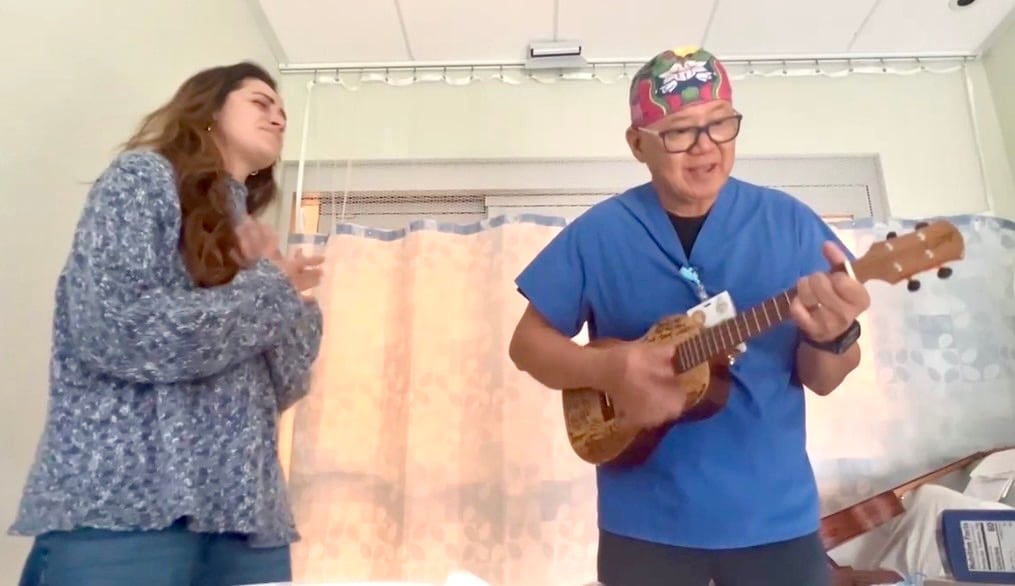
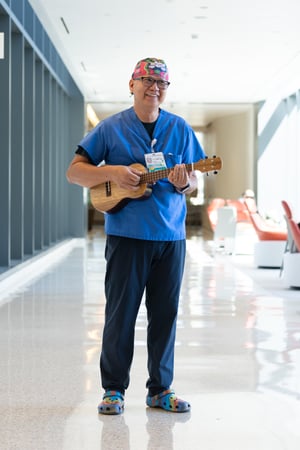
Because Rod brings more than clinical skills to the bedside: he brings a ukulele.
Where Healing Becomes Human
Rod’s journey in nursing spans more than three decades, from a childhood in the Philippines to critical care and post-anesthesia care nursing in the United States.
Across settings, one truth has remained constant:
“Healing is more than a physiological process; it’s deeply human.”
And it starts with something deceptively simple: presence.
“The greatest thing you could do for your patient is your presence. Your presence is as good as the medications you're hanging.”
In Rod’s hands, presence becomes the foundation for transformation.
“It’s an incredibly vulnerable time for parents. They’re in an unimaginable position. Speaking with them and easing their discomfort is an important part of the job.”
Transforming Fear into Hope
Rod’s impact is perhaps best understood through the patients whose lives and stories he helped transform.
Victor*, a young man in multi-organ failure, lay surrounded by uncertainty. His family kept vigil, clinging to hope that felt increasingly out of reach.
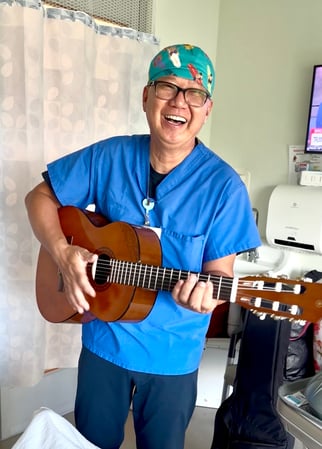
When they shared how much Victor loved music, Rod responded in the only way he knew how: he brought in his guitar and played.
“It gave them a language of hope.”
Day by day, the room changed. Not just clinically, but emotionally.
“He didn’t just wake up: he fought back.”
Six months later, he crossed the finish line of a five-mile race, with Rod there, playing the song he had written for him. Victor also gifted Rod his first ukulele.
Another patient, Ernesto*, arrived after a devastating fall, his prognosis uncertain. On Christmas morning, he woke from a coma and turned to his mother, mouthing: “I love you.”
He would go on to fully recover, and later invited Rod to play his ukulele at Ernesto’s wedding.
A Different Kind of Clinical Tool
What began as a gesture of gratitude became a defining element of his practice and a new kind of clinical intervention.
With soft, steady melodies, he eases fear and creates moments of calm that medication alone cannot provide. Monitors quiet. Shoulders drop. Families exhale.
“You bring the instrument at the bedside and now the room changes.”
It’s presence amplified; an intentional act of care that bridges science and humanity.
“The doctors write the notes, but we’re the conductors making sure the patient is center stage.”
Nurses guide the experience. They connect technology to humanity. They hold the rhythm of care together.
And sometimes, they go beyond what’s expected, finding creative ways to help patients engage in their own healing. Singing becomes a breathing exercise. Rhythms become movement and exercise. Participation becomes recovery.
The Nurse as Bridge, Advocate, and Healer
Rod sees nursing at the intersection of technology and humanity:
“We’re the heartbeat of healthcare, the bridge between the machines and the patient’s reality.”
Nurses translate complexity into understanding, serving as advocates, teachers, and artists in how they shape the patient experience.
At the core is a simple truth:
“Every nurse carries a superpower: caring. The power to turn fear into trust, pain into comfort, and uncertainty into hope.”
How has a nurse impacted your life? Share your story at ThePowerOfNurses.org.