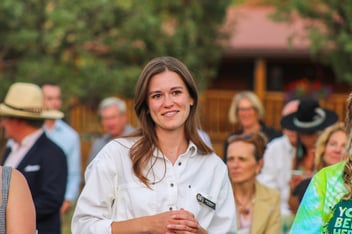


When Jamie Santos, RN, decided to pursue nursing, her family wasn’t exactly supportive.
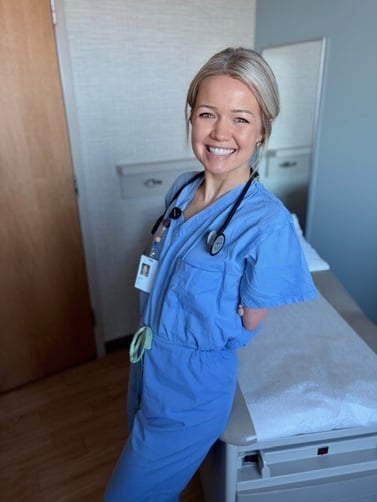
Her family members, several of whom are nurses, believed in her determination. But they also wondered how someone with one arm would navigate a profession known for its technical skills and fast-paced clinical environments.
“People kept saying, ‘I think you could be a nurse, but I don’t really know if you can do specific skills,’” Jamie recalls.
Jamie has spent more than a decade proving that she can.
Turning Determination into a Career
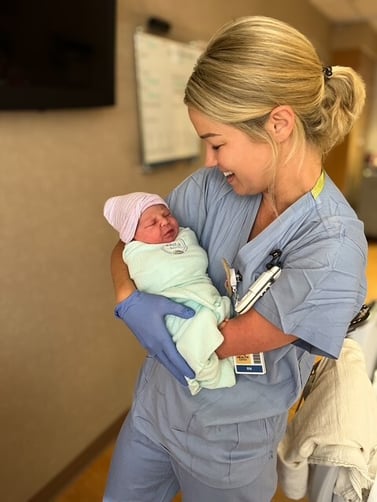
A nurse, disability advocate, and mother of three, Jamie has worked across multiple specialties, including neonatal intensive care, labor and delivery, and now breast health. Along the way, she has become a powerful voice for disability inclusion in healthcare, showing patients, educators, and aspiring nurses that ability is not defined by assumptions.
Jamie grew up surrounded by nurses, including her mother, sister, aunt, and brother-in-law. She was drawn to a profession centered on caring for others and attracted by the flexibility nursing offers throughout a career.
What she did not have growing up was someone who looked like her.
“I remember wishing I knew another nurse with one arm,” she says. “I wanted someone to tell me it would be okay. Tell me that I could do it.”
That absence became a source of motivation.
Today, Jamie uses social media to share her experiences as a nurse with a limb difference, offering the encouragement she once searched for. Through videos, conversations, and advocacy, she helps young people with disabilities envision futures in healthcare that they may never have thought possible.
Challenging Assumptions in Nursing Education
Jamie faced obstacles on her path to becoming a nurse. Some of the most difficult moments occurred during her schooling, when educators questioned whether she could perform certain tasks because of her disability.
One instructor expressed concern that Jamie might not be able to wash her hands properly. Another suggested she might not pass nursing school because a sterile catheterization procedure was difficult to perform one-handed.
“I remember going home and crying,” she says. “I thought, if this is what nursing is going to be like with one arm, maybe I shouldn’t do it.”
But Jamie found ways to adapt. She spent hours practicing skills and developing techniques that worked for her. In clinical practice, she discovered what nurses know to be true: healthcare is a team effort.
There are very few tasks Jamie cannot perform independently. For the handful that require assistance, she simply asks a colleague to step in.
“Not being able to do one or two skills shouldn’t be the reason somebody can’t become a nurse,” she says. “I can do the thousand other skills.”
Jamie hopes nursing education continues to evolve toward greater inclusion by helping students identify realistic adaptations and solutions. She believes educators can make a difference by starting with conversation rather than assumptions.
“Ask how someone likes to learn. Ask how they want to be supported,” she says. “That transparency would be so much more helpful.”
Connecting with Disabled Patients
While Jamie has encountered barriers, she has also experienced the unique connection that can form when patients see themselves reflected in their caregivers.
Throughout her career, families have sought her out because of her lived experience.
She has comforted children facing amputations after traumatic injuries, supported oncology patients preparing to lose a limb, and helped deliver a baby born with one arm.
“These are experiences I’ve had only because I have one arm,” Santos says. “You connect with patients and families in a way I can’t even explain.”
Jamie is proof that diverse experiences strengthen the nursing workforce.
The Power of Nurses™
Jamie is proof that diverse experiences strengthen the nursing workforce. Her message to aspiring nurses with disabilities is simple:
“Just do it.”
How has a nurse impacted your life? Share your story at ThePowerOfNurses.org.